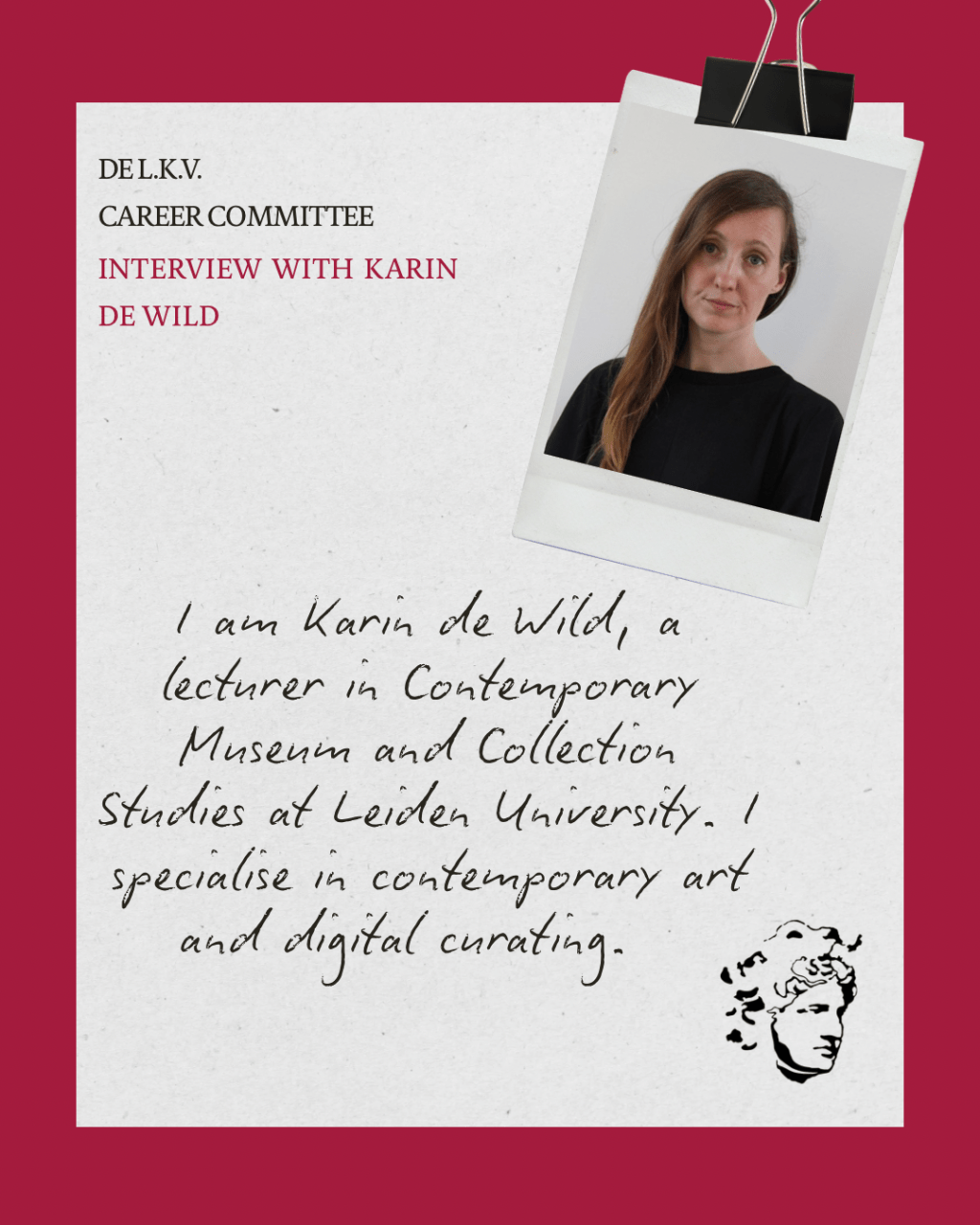
Date: March 19, 2026
Interviewers: Panagiota Tsoutsa & Nova Poelstra
Giota
So just an introduction to what we’re doing in this committee, because I think it would be useful in this part: we’re basically reaching out to people that are working in the field of culture, and we’re interviewing them, asking them how they were able to find their work, what exactly changed over this period that they have been working in the cultural field, and if they have any advice for the people that are aspiring to enter this field now. And I think I found your profile on LinkedIn. I’m not sure if it’s you, but you have been working in lots of institutions.
Karin
Yes, absolutely, yes. I had a lot of jobs. It could be my LinkedIn profile, but I haven’t updated it in forever, so it would be an old profile. I started working actually before I did my master’s, when I had gotten a job as a curator in media and moving art. They’re still situated in Rotterdam, which was the Centre for Contemporary Arts, and at the time, they had been an artistic arts agency, basically. And they received funding from the government for the first time, so they could hire staff, and I was lucky that they could hire me as a curator there.
I was very young, I had no experience at all, and I was super lucky that I could grow into that organisation. They said, “We want to know what’s going on… what is the newest generation of artists up to?” So, I started visiting the arts academies and just trying to figure that out together with my colleague at the time.
I was very interested in socially engaged art at the time, and my colleague was very interested in the post-internet generation, which nowadays has really established itself, but at the time, they were just coming off the arts academy; there was nothing yet. They didn’t establish themselves yet, the way that they have now.
So we made our first exhibition, trying the best we could, which you maybe also will experience if it’s the first time you can do it. But it was a really nice environment because it was full of young people, so we all needed to learn a lot, but that space was also there, and there was a lot of good energy.
I had a bachelor’s, but I didn’t have my master’s yet, so I felt I needed that as well, so I applied for the Master Curating Art and Cultures in Amsterdam, which is at the VU (Vrije Universiteit Amsterdam) and the UvA (University of Amsterdam). And then I had gotten in, and that was very nice, because then I could further develop a little bit more of my practice.
They did want me to stop working as a curator to do the studies, which, on the one hand, I can totally see, but for me at the time, that was something difficult. As you all know, when you have a job as a curator, it’s like, “I don’t want to let go of that.” But I think, if I look back on it, it’s good that I needed to really get out, take the step, and then move on. And then I moved on to a private collector who hired me; Henk van den Berg, who just lived outside of Rotterdam, had gotten an estate and two buildings on that estate, and he said, “This is where I’m going to build up my collection and display it.” And that was very nice, because I had never worked on a collection, only with contemporary artists.
So I learnt a lot about how to do acquisitions. And we went to a lot of art fairs: Tefaf, Art Basel… and I could just also get familiar with the art market. And I think it’s really important if you’re a curator, and especially with institutions that collect, that you start understanding the art market as well and how that is working, because that’s a world totally different from making exhibitions.
But besides that, I could also still do exhibitions. So that was nice. And that’s also what I did. And then he even said, like, “You can also do a little bit like your project, but really, where your heart lies.” And then I said, “Then I would really like to work with an artist duo, JODI, they’re called; they’re making internet art.” So actually inspired by my previous colleague on the post-internet, I thought I would really like to do something with them. And we did, and we made an exhibition with them, which was super nice, working on their website, Jodi.org.
Around that same time, at the VU, I had a conversation with my previous supervisor, and he said, “What are you doing now?” And I explained this to him. He said, “Wow, that could be a PhD.” And I had no idea what this was. So I was like, “Well, great. But I’m just making exhibitions. I don’t know.”
And then I started to have conversations with the professor at the VU University, Katja Kostek. And she is specialised in digital arts. And she started talking with me about the exhibition. And in the first instance, I thought this was super nice because I’m making this exhibition as well. So it was really shaping my thoughts on the exhibition as well and giving me an opportunity to dive deeper into it. And on the other hand, I also started to see more and more how this could be research on its own. So we questioned, what is actually this digital art? How to curate it? How to display it? How to collect it? All these kinds of questions, which really had my interest.
Then before we could even finish a proposal within Amsterdam, there came a vacancy in Dundee with someone who specialises in curating digital arts. And the professor in Amsterdam said, “Maybe you want to apply for that, because it also gives a good deadline to round up or really make a proposal in something tangible. Otherwise, it also stays a little bit in the air.” And I thought, “That’s a very good idea! Let’s apply for it.” And I got hired, too!
That was a bit of a strange moment because I was actually building up everything in Rotterdam. And then from one moment to another, I needed to move to Scotland and then have a PhD there, which was, OK, really something I was admiring, but I didn’t know what that would actually 100% entail. I didn’t have a long time to decide, but I did discuss it with a few people around me, and they said that it could be a nice opportunity.
So I switched, and I quit my job as a curator, and I went to a full-time PhD in Dundee. But there I had the opportunity to get a PhD, which is a bit unusual in the Netherlands, where I could make exhibitions but also do a PhD. So I became part of a new curatorial team of a digital arts festival that they’re doing in Dundee, the NEoN Digital Arts Festival. I was also involved with a lot of exhibitions that were created there. So I made an exhibition at the Dundee Contemporary Arts Centre. But I could also do my PhD at the same time and really research digital arts and how to display digital arts and do it at the same time.
I found it complicated, to be really honest. I didn’t know yet how to combine that practice with research. So I went back to where I understood research better, which is in art history. So in the end I made a very art historical PhD on digital arts, in which I studied the agency of digital arts and internet art in particular.
So great was it that I was also close to St. Andrew’s there. They have a really great art history department. They were very helpful in helping me with the art historical side of it. Because in Dundee, they didn’t have an art history department. So I was like, okay, I was talking with people from computer science and from biology, and you get a bit confused if you do that too much. So I needed to go back to my own field and have a bit of support, and they were really helpful in that. And then I had a good team of people around me, like one who was a philosopher, one who was a computer scientist and one who was an art historian. And from there on that worked very well. So there I’ve written my PhD. Then I was done with my PhD.
And then I started looking for post-docs. And I found one, luckily. It’s not easy, I found, to go into a postdoc position in the arts. You see that a lot of PhD students in art history tend to go slowly into their positions because there are very few post-doc positions. But luckily, I found one. And I found one at the University of Leicester, also within the United Kingdom. And they are known for museum studies. So a lot of the books that we read here are coming from Leicester. And there I got a postdoc on digital transformation in museums. So I could collaborate, again, with a museum. That is very UK-like. You collaborate all the time with the museums and cultural institutions. Something I think is really, really good. It really brings research into the field in the United Kingdom. So I could work, in that case, with the National Museums of Scotland, which is the biggest science museum in Scotland. And that is in Edinburgh. So I was actually, while I was also within Leicester, also in Edinburgh at the same time. Just to let you know, that’s a six-hour train right in between those cities. But that was all very well arranged, because I was based in Scotland. So I could go to Edinburgh very easily, and that was my base. So I was mainly in the museum. And then once in a while, I could just stay over in Leicester for a couple of weeks. And they arranged hotels, and I could just do a short time, like be there. So it was really well arranged. It was really nice.
And then I worked really within the team of the National Museums of Scotland, working on how they deal with ‘digital’ within their curatorial departments. So I learned a lot also about the practice within those museums and what that then means. So being really within the museums, working with what they do with digital in many ways. I’d have to say, I had a super nice time there. But postdocs are very short; mine was two years. And then you have to apply again. And then I was super lucky, because at that time, the positions here in Leiden were all in museum studies. So I had two vacancies here in Leiden that I could apply for, and I applied for both. And then, luckily, I was invited for both interviews. So then you know, okay, that possibly something is interesting about my profile. So that helped. If you go into an interview like that, it feels a bit calmer than if you were going to only one. And then they hired me. So this is the smooth path that you hear.
And it is also, if you see my CV, great. No stops in between. But I do think it is important to know that within this whole pathway, there were a lot of rejections. Like, it is not that I applied for something – I got in; great! Next, I apply. I think within the arts, you apply more than what you get. So in between, it is not that I applied only for this; I applied for 20 or 30 other things as well, all of which I was rejected for. And I think sometimes it is important to tell that as well. If we were to show our CV of all the positions that we were rejected for, it would be so much longer than if we showed the CV of the successes. And I think it is really important to know because if you are going into the arts world, I mean, we are not computer science or something. Where I see where it can be much smoother, and people are already scouted when they are in the uni. Like, can you work here, or can you work there? Or they can stay at their internships quite often.
I think within the arts, the routes are a bit more rough. You need to apply a lot. And yeah, it is partly because there are not so many positions. So sometimes you need to find your way a little bit before you are getting the positions. Like, often the ones that you are most nervous about because you think, “oh wow, this is what I would really like,” most of the time are the positions that you get hired for are because you have the skill set to do that.
Giota
That is really interesting. I have a lot of questions. The first one is because I saw that you had a lot of internships, and I want to ask if you would recommend us to apply for a lot of them and if you learnt a lot of things from them.
Karin
Absolutely. Yeah. For my first job as a curator, I was hired based on my internships. So I was an intern at the Queens Museum in New York and at the Stedelijk Museum in Amsterdam which really helped. So, yes, I would definitely recommend that you do an internship.
I also think that when you want to become an academic, then focus on getting very good grades and do a research master. But if you’re not sure yet and you’re thinking, “Well, I would like to explore the cultural field as well,”or you know already that you want to go into the cultural field, then I really think you should do an internship because that is what you don’t learn at the university. What is it to really do the job, and what are the important skills you need? You will also see it in the vacancies. So if you already have an idea of what I would like to do – “I want to become a curator, or I want to become a collection registrar, or I want to do a public programme in a museum” – then look up the vacancies and see what they ask from you. And you will see for a curator, especially, I mean, you start as an assistant curator, but they already ask for experience. And so you need to get that experience from somewhere without having the job yet. And then internships, of course, can give you that experience.
Giota
How were you informed about these internships? Because now we have sites like Call for Curators. But sometimes I do not think that all the ads are there. Did you reach out to institutions individually or…?
Karin
I know why I chose them. Like, I was naive, but also in good naiveness. I went to the museums I like best. So I just looked at a lot of museums, and I thought, “This is great.” I didn’t know if they were important in the field or not. I just walked in, and I thought, “This is a great museum; here I want to do my internship.” And then I tried whatever I could to get in contact with the right people.
But for going to New York, I had an agency that actually helped students from the Netherlands to get into an internship in New York. I forgot the name of them. But they helped me to get in contact with the Queens Museum. So they were helpful on that.
But in the Netherlands, no, I really just walked around the Stedelijk museum and thought, “This is what I want to do.” And I just started to build my network in Amsterdam to find out who knew anyone who was working at the Stedelijk Museum to try to get in. Well, I cannot say that, like, in the time I thought, everybody could do this. Now, I’ve heard other stories as well. I think I have been extremely lucky. So, but it is, yeah, it is a way of doing it, I guess.
Giota
And I have another question, because I think that it is really hard to build a network. We all have this; at least I have this idealised idea in my mind of Paris in the early 20s, where all the important artists and Gertrude Stein and everyone were hanging out. But it’s not like that at all. So how were you able to build that network?
Karin
Yeah, now I’m sometimes a bit more strategic about it, but at the time, I was just very enthusiastic about what I was doing. And I spoke about it a lot with people without even knowing it. So when I went to a birthday party, people were asking about what I was doing. I would tell them, “I am doing this amazing internship.” And then they said, “What?” And I said, “Well, I’m working on this statue that we’re doing a restoration on. And it’s like, interesting here and interesting there…” And they asked, “Do you want to make your job out of it?” And I said, “Well, yeah, if I can.” And then I was luckily talking to the right person who knew of a vacancy. So maybe it is, but again, I feel like I’ve been extremely lucky in the beginning. So this will not work for everybody. But be aware that, if you love what you do and you project that, the people around you might be connected to people in the arts and bring you to that.
One thing that I did do was that I went a lot to exhibition openings. But I have to say, I think that is extremely difficult when you’re younger, because you don’t know anyone yet and everybody is networking there. So everybody goes to the person that they need to, that they know or like need to ask something. And then if you come in younger, it’s difficult. But I do think it’s good to come, sometimes to the opening of exhibitions, because you can see the exhibition. You do know after a while who is who, which can be of help because you know them. So you can go to them and say, “Hey, I really admire the last exhibition that you made. I really wanted you to know that.”
I was extremely lucky that I did the right thing. Like, I got these internships. So they really introduced it to me like, “If you get an internship at Stedelijk, you meet a lot of people.”
I also had an internship at the Kröller-Müller Museum, so that’s the third one. Met a lot of people through that. So internships are also a way to build up your network, and you have a concrete project you can talk about because you’re working on it. That helps. The other thing is that my programme was very well connected. So…
Giota
The programme in Amsterdam?
Karin
Yeah, in Amsterdam.
So you were always meeting curators, and that helped me a lot. I think here the program is also very well connected. So, because here we have, for example, Wonu Veys, who’s a curator at Wereldmuseum Leiden, at our department. Ad Maas, the curator at Rijksmuseum Boerhaave, is working in this department. Dick van Broekhuizen, curator at Museum Beelden aan Zee, is working in this department. So if you want to do an internship, you can already start with them and ask, “Can I do my internship at your museum?”
Giota
That’s how I did mine.
Karin
That being said, in Amsterdam, there were a few curators who really worked in the department. They were connected well to curators. But at that time, it was more the network around it. The internships that connected us to the field. Um, so yeah, different, different routes. But I think museums or the universities have good connections to the museums as well in the art history programme. Make use of that, and don’t be scared to ask people something. So if you really like to do an internship, and you go to an opening of an exhibition at your favourite museum, and the curator is there, I would just give it a try. They will tell you if it’s not working out or if they’re too busy. But who knows? They can also say, “Yeah, of course, this is where you need to write an email to!”
Although I have to say, I have the feeling that the internships have been a bit more formalised in the museums now. Now they have vacancies, and you have to apply for that. In the time that I was doing my internship, it was a little bit less formal. But still, you can give it a try, I would say.
Also, another thing that you can do is that there are a lot of workshops within museums as well. Um, I didn’t do that back then, but now I do it a lot. Because some of these workshops are of interest to me, I just follow them. Workshops on archiving, workshops on how an exhibition is made, or certain discussions within the cultural field. That helps as well.
Giota
And compared to when you started, do you think that things now are easier? Or more difficult?
Karin
Well, I mean, I have the feeling it became more difficult, to be honest. But it’s so difficult to compare, but I have the feeling there are more students in the art history departments, and there are fewer positions within the cultural field. This is purely intuitive, but I have the feeling that the competition became harder than what it was.
But it’s very hard for me to compare. And, this is also intuitive, but I have the feeling that because we’re so much more online, it’s more difficult to connect to each other in the real world.
So what I tell you about the openings, for example, it went a bit like that. After a while, they were like, “Hey, I’ve seen you here before.” Like now, I have the feeling that if I go to an opening, there is a waiting list of a hundred people, and you need to immediately sign up within an hour. Otherwise, it’s full. And these kinds of things I cannot remember.
Giota
With the Nieuwe Instituut, the exhibition about fungi sold out immediately.
Karin
Yeah. So these kinds of things I cannot remember that I had. And I think because of it, we all become a bit more anonymous to each other. Um, but yeah, this is also a bit intuitive. I did hear from a lot of curators, and this is something I never did. Instagram has become very important to build up your profile there, to show that you have done certain things there. Like these kinds of things, I never engaged in. Um, so I cannot tell; I still don’t. That is, of course, also a routine to show what you have done. Do small projects here and there and have good photos of them.
Giota
And the last question that I have, um, would you give any advice to your younger self? Which is the classic question that they do in interviews.
Karin
Well, I think personally, I have also worried a lot. Because we have a field that is quite competitive. And then I thought, “Oh, am I good enough to get into it?” And I would say, “Don’t do that. It’s a waste of your time.” Uh, if you do get into it, it’s also a bit of luck, and you will, and if you don’t, you will go into another route, and you will become happy there. So getting so worried about that, you get this position that you dream of when you’re very young. I think it holds us back in life. And I wish I hadn’t worried so much. I ended up somewhere else than I expected when I was young. I expected that I would value other things than what I value now.
So, yeah, all these worries about, “Do I end up in the perfect job?” Life leads us wherever, and we’ll see.
Giota
I saw that you have been travelling a lot. Is it easy to leave everything behind and move to another country for work?
Karin
I assume you travelled a lot. Where are you from?
Giota
Oh, Greece.
Karin
It’s a very good question. And it’s a question that I only get from international students. I think it sounds amazing, travelling a lot. It sounds very exciting. And I think that’s how we step into it in the first place. I think it’s very enriching to be in a different environment, to see a new culture, to be part of that, and to be embraced by it. But it’s also leaving behind your social environment time and time again. And that is sometimes also really hard. On the other hand, you also learn how to have a social environment, like my friends are spread around Europe. And I know how to stay in contact with them, even over such a big distance. And I think you learn that everyone who has, who has crossed countries, has this.
I have mainly stayed within Europe, so I haven’t even had the experience to go around the world; I have colleagues who did. I think you learn how to stay in contact with people that are valuable to you in another way.
Giota
So is it worth doing?
Karin
Yes. I would recommend it to everyone to at least leave the country they have lived in for a little bit. I think in our time, but it might also be Leiden; we’re a very global university, so we’re actually valuing it a lot that we engage with people from different cultures. Um, but I think it is also really enriching to know how it feels when you’re not in your own culture. Um, I think it’s a really, really good experience to have, both the positive and the negative sides of it.
Giota
Yes, I totally agree.
Thank you so much for the interview. It really helped us. You’ll be the first person that will be posted.
Karin
Wow, thank you! I’m so honoured.
 De L.K.V.